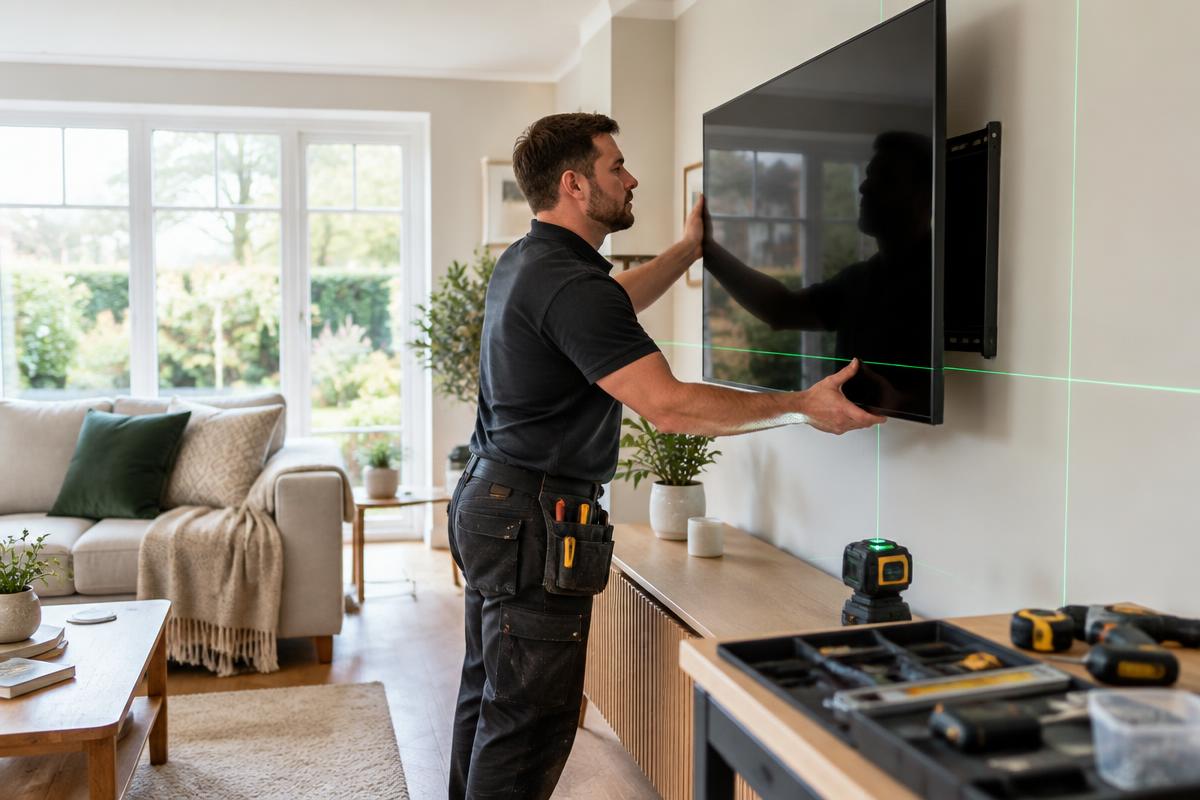
Choose a position for living, not just looking
A mirror can look perfect in an empty room and feel awkward once the door opens. A television can sit neatly above a cabinet yet be uncomfortable from the sofa. Before discussing fixings, try the intended position in the room you actually use.
Mark the outline with a method that will not damage your finish, or hold a paper template in place. Look from the usual seat, check opening doors and allow for curtains. For a shelf, consider the objects it will carry rather than treating the empty board as the whole load.
The postcode does not tell you what is behind the plaster
Richmond and Wimbledon include period homes, while Brentford has modern apartment developments as well as older buildings. That local context is useful for planning access, not for choosing a fixing. A single property can contain original masonry, later partitions, repaired plaster and boxed-in services.
Tapping a wall or guessing from the age of the house is not enough to specify a safe installation. The item, its fittings, the supporting material and the condition of that material all matter. A professional needs to assess the actual mounting position. Concealed pipes and cables must be considered before drilling; uncertainty is a reason to pause, not to try a longer screw.
Make an item file before booking
Find the model number, dimensions, weight and installation instructions. For a television, include the bracket model and confirm its compatibility with the screen. A bracket that extends away from the wall places different demands on the installation from one that holds the screen close to it.
For a mirror, photograph the rear attachment points as well as the front. For shelves, describe the intended contents. Books, ornaments and occasional lightweight display items are not interchangeable loads. Avoid buying fixings simply because the packet says “heavy duty”; suitability depends on the complete installation.
Your planning checklist
- Item model, size and stated weight.
- Bracket or hanging hardware details.
- Photographs of the wall and the back of the item.
- Intended position and, for shelves, likely contents.
- Any known building restrictions or permissions.
Keep the finish and the permission in the same conversation
In a rented flat, obtain any permission required before the appointment. In a managed building, ask about drilling restrictions, working hours and access arrangements. If a property is listed, or protected features may be affected, check the relevant requirements before altering them.
Decorative plaster, wallpaper and older finishes deserve a separate conversation. Explain what must remain untouched and whether any previous holes need making good. Mounting an item, repairing an old fixing point and redecorating around it are different pieces of work; do not assume one automatically includes the others.
Know when to stop
Cracking, crumbling material, uncertain services or an unsuitable mounting point can change the plan. If potentially hazardous material is suspected, do not disturb it to find out what it is. Get appropriate specialist advice. This article is a planning guide, not a drilling or fixing specification.
Heavy and awkward items may require two people for handling, independently of the time needed to prepare the wall. Share the details so the right team can be recommended rather than choosing a crew solely to minimise the hourly rate.
What a good handover looks like
Agree the final position before holes are made. Afterwards, ask what the installation is intended to support and keep the item and bracket instructions. Do not add a heavier television or load a shelf differently later without checking suitability.
Furniture anchoring is related but not identical to hanging an object. IKEA’s Secure it guidance stresses attaching furniture to the wall using the appropriate restraint and hardware for the wall type. If your visit includes a chest of drawers or wardrobe, include its anchoring requirement explicitly in the brief.
Hello Handy handles mounting and hanging across our supported TW, KT, SM, SW and GU areas. Send the full postcode and item details for a quote; coverage does not itself confirm a particular appointment.
Sources & further reading
IKEA UK — Secure it: furniture tip-over prevention and wall anchoringHello Handy · Local help
Ready to make a start?
Share your postcode, job details and preferred timing. We’ll help you plan the right visit.